


“In Conversation” is an ongoing interview series built around the ways time and weather exist in the life of books and their authors.
(Why time and weather? Because we can’t help ourselves. After all, we’re the folks behind Author Clock and Author Forecast!)
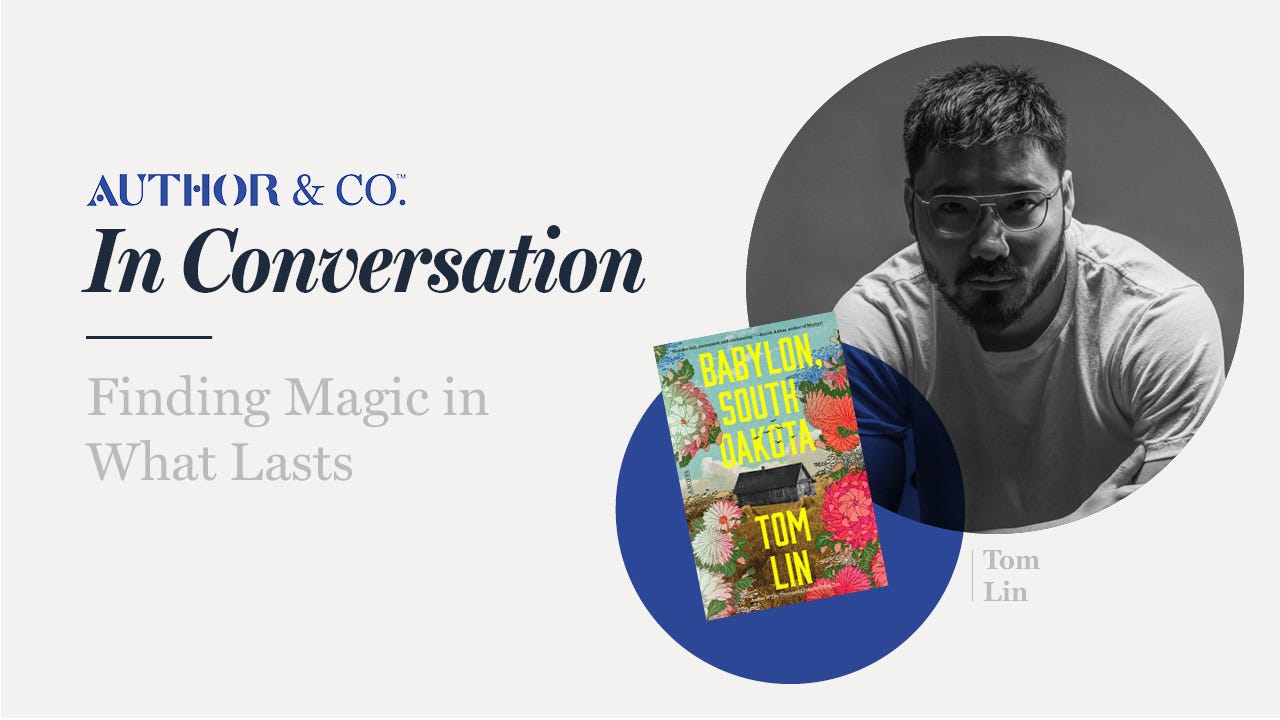
IN BABYLON, SOUTH DAKOTA, Saul and Mei Hsiu are Chinese immigrants trying to make a life for their family on a South Dakota homestead they’ve inherited. The seasons change, and the family grows older in a place where time is felt in the weather and in the land. But the Hsius have not moved to just any piece of land. Part of their property is taken over by the U.S. government, and a nuclear missile silo is built beneath it. Above ground, daily life on the homestead continues. Underground, something secret is keeping another kind of time.
“Ultimately, it’s a book about death, but also about what it means to spend time with one another, to mark the hour, and to know that we’re all kind of getting old at the same time.”
HOW NATURE KEEPS TIME became clearest to Tom in the difference between the city and the homestead. He grew up in New York City, where weather is moved through quickly, from a subway platform to an office lobby, to a heated apartment. On a farm, there isn’t the same degree of separation. Weather changes what the day can be. Rain can cause delays, heat can exhaust the body. “Nature can keep time,” Tom says. The year becomes physical: visible in the crops, the air, and felt in the different modes of labor required by each season.
“Everything feels so permeable to nature and to time.”
IMPOSSIBLE AND IMPROBABLE conditions are easier to imagine once a story has already been told. Tom spoke about early missile engineers who had grown up reading stories like Buck Rogers, and how science fiction gave them “a common language” for technologies that didn’t exist yet. In Babylon, South Dakota, that impossibility becomes concrete: a nuclear missile silo beneath the Hsius’ land. The farm is still a farm, but it now belongs to two kinds of reality at once.
“There’s only really one mode of cognition that we have when we think about things that are impossible or improbable or far future… And that’s the mode of science fiction.”
FORCES OF NATURE and of forces of government become intertwined in Babylon, South Dakota, and both make the Hsiu family feel small in the face of something larger than themselves. Tom defines the sublime as the feeling of being “very small next to a very large thing.” Weather can be unforgiving and brutal, but at least it makes itself known. Government power is guarded, spoken in a language the family can’t fully understand. The Hsius live under the weather and over the silo, affected by forces that can change their lives without ever fully explaining themselves.
“You, along with everyone else, along with all of the world, is drawn along by these forces that are kind of beyond your control or understanding.”
SEASONS OF GRIEF arrive on the homestead after Mei disappears, when Saul loses his place in time. Tom spoke about grief as a state in which “the world seems to stop,” followed by the shock of realizing that “everyone else has kept going.” For Saul, the farm’s greening is painful because it means continuation. The seasons have moved on, as they always do, and no amount of feeling can stop time or slow it down.
“No one has waited for you. And no one has kind of put their hand on the throttle and given you a break.”
THE TRANSLOCATION OF STORIES is what happens when family stories travel through enough time. A story from a parent or grandparent, especially one carried across countries and generations, is met with some willing suspension of disbelief. The story itself has crossed so much distance that its survival becomes part of its meaning. Time can “calcify” stories, but it can also “forgive narrative sins.” And at a certain point, the fact that the story survived becomes part of its power.
“It matters that it made it. Not even that it’s true, or that it’s verifiable, it’s simply powerful because it is a narrative fragment which has lived for so long.”
THE LIE OF NARRATIVE is also the comfort of narrative. Tom described it as the belief that one thing happened because of another, and that life can be understood as a chain of causes and consequences. Without that, life can feel like “Class IV rapids” we are “white-knuckling” through, moved forward by events we can’t control. Stories help us look back at the rush and find a current. They turn coincidence into pattern, and pattern into meaning. Similarly, science fiction gives the impossible a language, and with enough time, what once seemed impossible can start to feel real.
“Everything seems magical if you wait long enough.”
Watch our full conversation here.
TOM LIN is the author of Babylon, South Dakota and The Thousand Crimes of Ming Tsu, which won the Carnegie Medal for Excellence in Fiction.
At the heart of AUTHOR & CO. is a love of reading, so we create tools that bring literature into everyday life in wonderfully unexpected ways.
Currently, our collection includes Author Clock—the clock that tells time through quotes from literature, and now Author Forecast, which pairs real-time weather conditions with passages from books.
Soon, when the weather calls for it, Babylon, South Dakota will appear in the forecast, bringing the novel’s stormy weather off the page and onto your bookshelf.

Learn more at authorandco.com