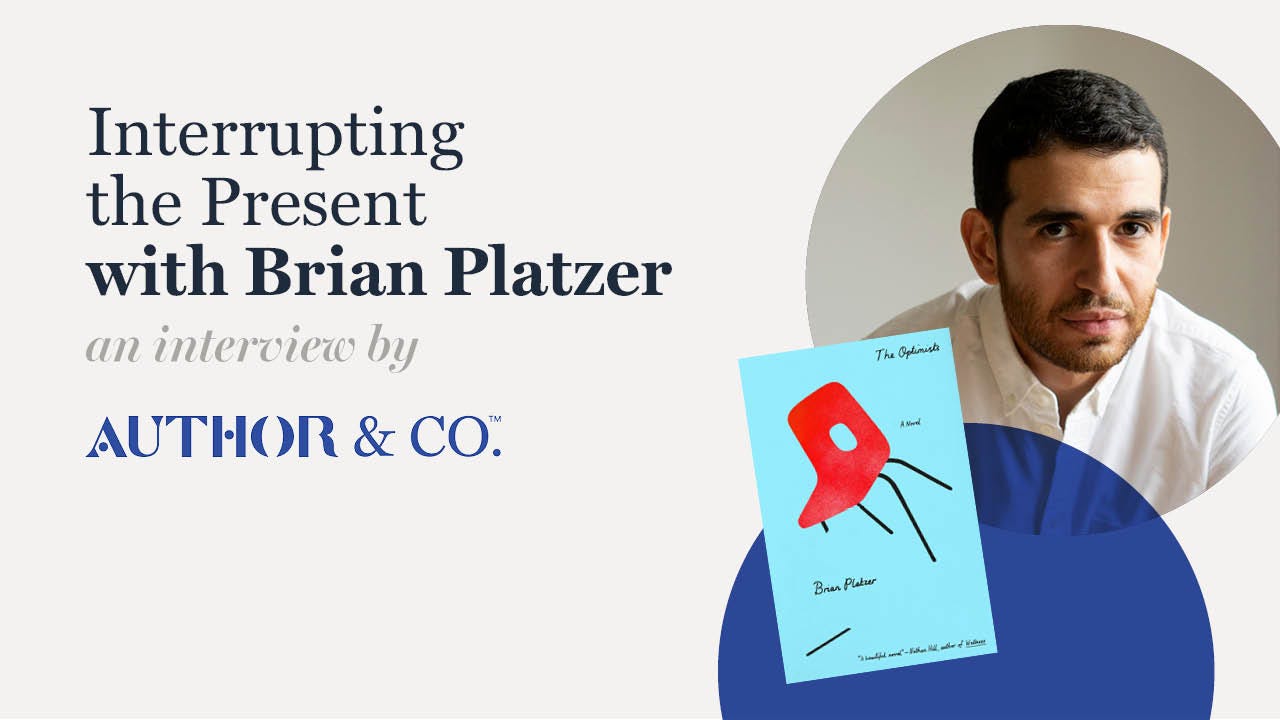
Brian Platzer’s The Optimists is narrated by Rod Keating, a man who has suffered a stroke, telling the story of an extraordinary student named Clara, despite his limitations of speech and movement. But Clara reaches us through the meanderings of his own consciousness, and his past continues to live within his present. The story that we get is one that experiments with the conditions of telling: the way memory loops forward and backward, and the fact that we can never fully describe another person without also describing ourselves.
“The Optimists is a book narrated by a man at the end of his life trying to entertain the reader best he can.”
—Brian Platzer
The origin of the novel is direct. Brian’s eighth-grade English teacher, Rod Keating, stayed in his life long after the classroom. They taught together and developed a close friendship that spanned decades. Then, a week after officiating Brian’s wedding, Keating suffered a massive stroke. He lost the ability to speak or use his body. Brian continued to visit him, reading aloud, talking through his life, and sitting with the fact that there would be no response.
Brian described the early drafts of The Optimists as a kind of accumulation, an attempt to capture everything his mentor, Rod Keating, might be thinking. Later, he imposed a more traditional structure, mapping plot and progression onto the pages. That version read more recognizably as a “book,” but something had been lost. As he put it, “it was lacking all of the love and imagination of the first draft.”
“I had this voice that was desperate to be heard, and then I had the playfulness of the real man I remember spending hundreds of hours with.”
—Brian Platzer
Everything changed once Brian gave his narrator permission to interrupt himself. Mr. Keating could pause, digress, revise. The book didn’t need to move step by step from one moment to the next; instead, it could follow and play with the natural movement of the mind, where one memory leads to another. In The Optimists, the story can’t be separated from the consciousness telling it.
The novel’s storytelling mechanism is one of “great pressure.” Though it didn’t work for the real Mr. Keating, the narrator of The Optimists uses an eye-tracking writing device. When “it works, it works,” Brian explains, but only through intense concentration, and it’s exhausting. Every word the narrator communicates takes a lot of effort.
“He wants every detail, even if it’s a joke, to be intentional and focused and precise.”
—Brian Platzer
Despite the exhaustion of communication, Brian writes the fictionalized Rod Keating with such tonal precision that the humor of the earlier man is still fully present. For example, the novel is dotted with jokes. Knock-knock jokes. As Mr. Keating says, “I’m a great believer in knock-knock jokes. Creativity within restrictions.” After the stroke, he lives under severe restriction, in both body and in speech. The jokes preserve the playfulness that defined him before, while also showing that his imagination is still active within those limits.
Mr. Keating remembers moments that wouldn’t have seemed important at the time, such as a brief exchange in a classroom, and other seemingly ordinary occurrences of passing days. Reading The Optimists is a reminder that memory doesn’t preserve a life based on scale and importance. Brian spoke about how “ten or fifteen minutes can have such an impact for the next fifty, sixty, eighty years.” Mr. Keating’s memories suggest that smaller moments that reverberate for years may stay with us just as much as the major milestones.
“Any of these moments could be significant in a way that you don’t anticipate, and that’s very, very exciting, and it’s anxiety producing.”
—Brian Platzer
For many of us, entire stretches of life can disappear while a brief interaction comes back to us in vivid detail. And when we’re young, everything seems urgent, so it remains a mystery why certain moments stick. That’s part of the “magic of childhood,” Brian explains, and it’s also part of the “horror of parenting.” Maybe we don’t spend enough time thinking about the teachers with whom children spend a year of their lives, how lasting that influence can be, or how children, in turn, impact the adults who teach them.
Mr. Keating also reflects on a life spent looking ahead, the tendency to imagine what comes next as a way of giving meaning to the present. Anticipation can make a mundane stretch of time feel tolerable; a person might look forward to Friday, to summer, to a vacation. This act of looking ahead gives momentum and excitement to the present moment—one of the ways people deal with boredom and life’s difficulties.
Still, anticipatory pleasure depends on the sense that something lies ahead. So, what happens when the future is no longer open in the same way? In the present, Mr. Keating isn’t anticipating life as he once did, but his instinct to look ahead doesn’t disappear.
“Although he might not have so many exhilarating episodes ahead of him, he does have a new chapter to write tomorrow.”
—Brian Platzer
Though he’s nearing the end of his life, Mr. Keating still thinks ahead. He continues to live in consideration of what comes next, even when the future no longer offers what it once did. Maybe that’s a form of optimism in itself: still looking forward, even in the simple relief of a summer day with no pressure to go outside and make the most of it.
When Mr. Keating sets out to tell Clara’s story, he also ends up telling his own. He can only approach himself at a distance—through another person and a different set of consequences. Clara remains central but the story is never only about her. Through her, Mr. Keating shares his attachments, limits, and memories. Clara is the subject, but the act of storytelling is a way to communicate the truth about himself.
“The third person is almost always just a narrated first person.”
—Brian Platzer
After all, when we tell stories about other people, our own perspective inadvertently enters the conversation. As Brian says, “We’re really just telling different versions of how the universe is affecting us.” Mr. Keating describes the events of Clara’s life, but in doing so, he also tells the story of Jacob, of himself, of teaching, of legacy.
By the end of The Optimists, we have a stronger sense of which parts of a person can survive loss. The narrator’s voice stays with us, along with his memories, even as his present condition places limits on what he can express. The novel doesn’t shy away from the regrets that come with a man looking back over his life, but at the same time, it keeps in view the small memories that continue to matter, and the fact that even now, as we close the book, Mr. Keating is still imagining what comes next.
-Yasmin
Watch the full interview here.
Brian Platzer was the education columnist for The Atlantic and has written frequently for The New York Times, The New Yorker, New York Magazine, and many other publications. He currently teaches and lives with his family in Brooklyn and Paris.
Yasmin Gruss is Head of Content & Community at Author & Co., where she curates the quote libraries for Author Clock, Author Forecast, and more.
At Author & Co., we combine design, function, and our love of reading to create tools that bring literature into everyday life.
Learn more at authorandco.com