


As the story goes, four people were trapped at Lake Geneva during the summer of 1816: Mary Shelley, Percy Shelley, Lord Byron, and Byron’s personal physician. When writing about that season, Mary Shelley described it as “wet and ungenial,” referencing one dark night in particular, when Byron proposed that they each “write a ghost story.” That was the night that inspired the idea that would become Frankenstein. From there, Mary Shelley, Lord Byron, and Percy Shelley would all move securely into the literary canon.
But in reality, there was one more person there, on the shores of Lake Geneva, and Mary Shelley wrote her out of the story.
She was Mary’s stepsister, Lord Byron’s lover, and she was the person who helped bring the group together in the first place! She was seventeen years old, and her name was Claire Clairmont. Despite her erasure, traces of Claire’s perspective still survive through her journals. However, one journal was never found: the one from the summer of 1816.
“This is a novel that is really the untold origin story of Frankenstein.”
—Emily Franklin
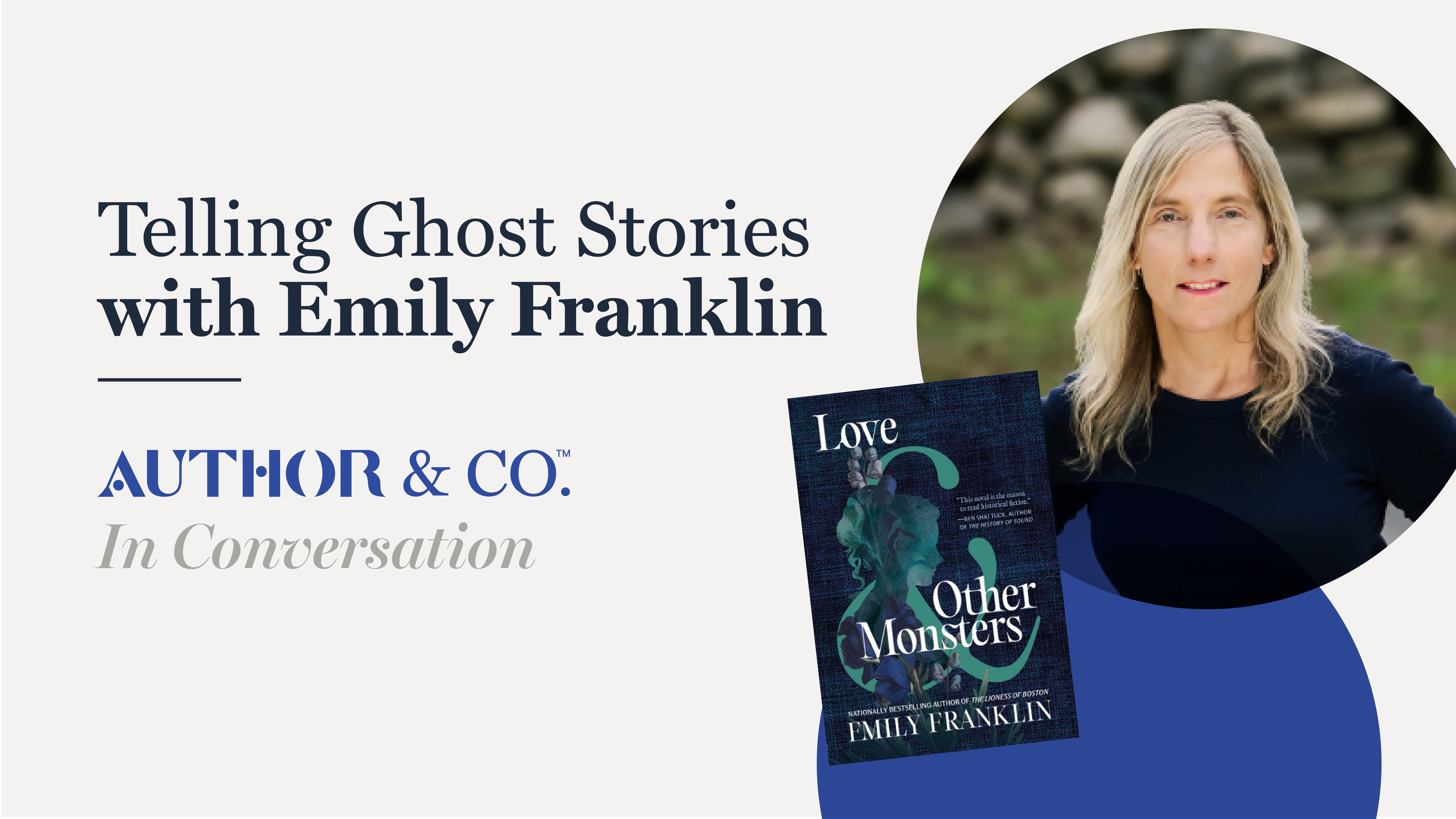
In Love & Other Monsters, Emily Franklin imagines the missing journal and uses it to recount one of literature’s most mythologized summers from Claire’s point of view. After reading the novel, Claire isn’t lingering at the edge of Mary’s story. She stands at its center, and now takes her place there in our literary memory.
The summer of 1816 is notoriously referred to as The Year Without Summer. Emily explained that the year before, in 1815, Mount Tambora had erupted in Indonesia, blocking enough sunlight to cause a global climate disaster. Crops failed, resulting in significant food shortages. There were typhoons, earthquakes, and hurricanes. The cause of the strange weather wasn’t identified until over a century later.
“Had it been regular summer weather, we wouldn’t have Frankenstein.”
—Emily Franklin
Through the imagination of Claire’s missing journal, Emily Franklin depicts the volatile weather of 1816, accurately referencing weather records from that year. During that season, Claire and the others understood what was happening no better than the rest of the world did. That kind of uncertainty changes the experience of time, as does the absence of sunlight. The days become slower, and everyone is indoors longer than expected, while something large and confusing unfolds outside.
The weather and conditions it creates work to heighten an already stormy dynamic. Claire is bound to Mary and dependent on Percy Shelley. She’s found herself in a consuming relationship with Byron, whose treatment of her is a combination of fascination and cruelty. They’re a group of young writers, and the mysteriously “topsy-turvy” world around them intensifies their ambition, jealousy, and restlessness.
And though The Year Without Summer was unusual, the human experience around it is not. I couldn’t help but think of the pandemic—the feeling of being trapped in one place, cut off from the world, still trying to live, work, have relationships, and make art in an environment of extreme uncertainty.
For Claire, the weather is felt first in the body, then in the mind. She notices it when she is sent on errands, when she listens to the sounds beyond the window, and when it brings her up against the limits of her own life. She can’t choose the weather any more than she can choose many of the conditions under which she lives. Tethered to Mary and Percy, she spends much of the novel without control. At Lake Geneva, she is surrounded by what Emily describes as the “celebrities” of the era, yet she is not granted the same standing, despite her own desire and aptitude to write.

Over the course of the novel, Claire watches Byron move through the world without restriction, doing exactly what she cannot. “I needed to do as he did and embrace whatever weather was given to us,” she says. Byron moves as though the world has already arranged itself around him. Claire has to adjust herself to whatever arrives, whether it is the weather itself or the desires of the people around her.
Mary Shelley understood what it meant to survive in writing. She was the daughter of Mary Wollstonecraft and William Godwin, and she was raised with an understanding of the connection between publication, reputation, and literary afterlife. When she wrote the Introduction to the 1831 edition of Frankenstein, she stated that there were only four people there on the night that inspired the story. Of course, we can’t know exactly why Mary removed Claire from the account, but Emily Franklin explores the possibilities in Love & Other Monsters.
“I thought to myself, well, where’s Claire? What happened to make Mary Shelley write Claire out of the story?”
—Emily Franklin
Emily spoke about Mary Shelley going back into Percy Shelley’s poems after his death and changing the dedications that referred to Claire. She changed some of the wording too. “We can see the scratch marks,” Emily said. So, Claire’s absence was not only the result of time passing. There was an effort to remove her from the page, and the evidence of that effort is still visible.
Claire survives only in letters, poems, journals, and traces left in other people’s writing. But she survives there with less authority than Mary Shelley, Byron, or Percy Shelley. As Emily puts it, “she won.”
The competition between sisters in Love & Other Monsters is bound up with recognition and the difficulty of becoming visible to someone whose opinion has helped define you. Claire depends on Mary materially and emotionally, and Mary seems to understand Claire partly as someone she has helped make. They love each other deeply, but they don’t know how to leave room for one another’s full personhood.
“She grew terribly resentful when Claire wasn’t exactly how she wanted her to be or had a life of her own.”
—Emily Franklin
Mary’s time is divided by work and motherhood, while Claire’s time appears looser from the outside, though she experiences that looseness as a lack of standing. She has no clear place to put herself. She is asked to be useful instead: muse, messenger, companion, lover. She lives inside other people’s purposes while trying to become a person to herself.
Mary has helped produce a version of Claire and then cannot bear Claire’s independence from it. This struggle is, at its core, how we understand Frankenstein. A person is brought into being through another’s vision, then becomes intolerable once she begins to exceed it. Claire is written all over this version of the story: the younger woman imagined, formed, relied upon, and then resented for becoming fully herself.
Though Frankenstein remains the most famous creation of that summer, Emily Franklin shows that Claire belongs to its afterlife too. Emily spoke about the way everyone we love becomes “a ghost of memory,” and about the earlier selves that remain inside us. Older Claire looks back on the girl she once was and tries to understand the distance between them.
“All love stories are ghost stories waiting to happen.”
—Emily Franklin
Emily said she wanted older Claire to have that Kierkegaardian sense of life being lived forward and understood backward. In this way, Claire can look again at the version of that summer that literary history preserved, and she can tell us a different version of the truth.
Near the end of Love & Other Monsters, Mary Shelley says, “A story changes. At the time, it is one story. Upon retelling the day after it is another and then years on, it is still another story altogether.” Emily Franklin enters that chain of retellings with Claire at its center. After reading the novel, Claire no longer exists in the margins of someone else’s account. She remains where she should have been all along: at the center of the summer that made the story possible.
-Yasmin
Watch the full interview here.
Emily Franklin is the bestselling author of more than twenty books, including The Lioness of Boston. Her work has been published in The New York Times, The Boston Globe, The Kenyon Review, and The Journal of the American Medical Association, among many other places, as well as featured and read aloud on National Public Radio, named notable by the Association of Jewish Libraries, and longlisted for The Sunday Times Short Story Award.
Yasmin Gruss is Head of Content & Community at Author & Co., where she curates the quote libraries for Author Clock, Author Forecast.
At Author & Co., we combine design, function, and our love of reading to create tools that bring literature into everyday life.
Learn more at authorandco.com